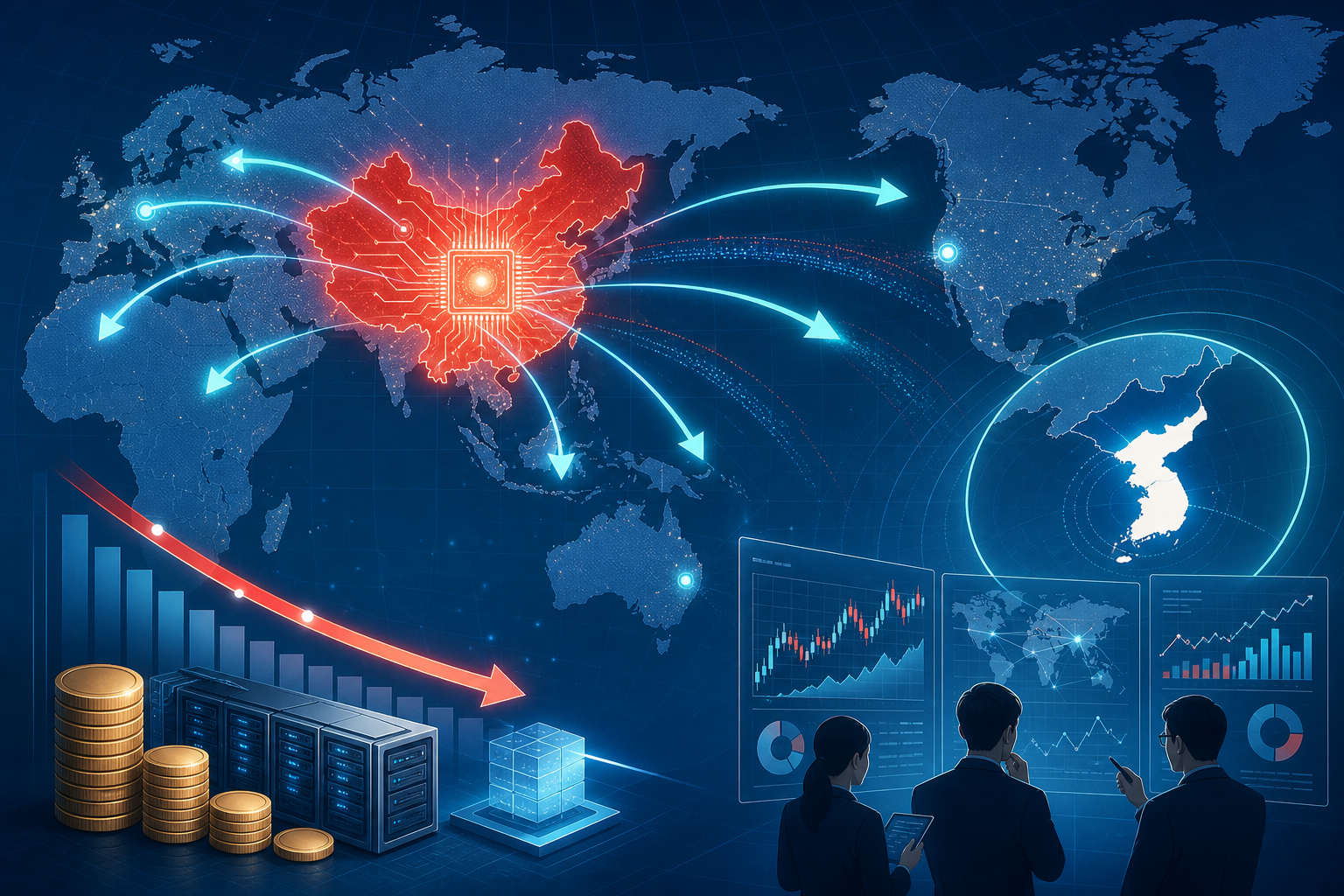
China’s AI companies have stopped trying to out-engineer Silicon Valley. Instead, they’re trying to out-price it — flooding Southeast Asia, the Middle East, and Europe with low-cost models designed for adoption first and monetization later. For Korean tech investors already navigating a brutal semiconductor cycle and a structurally vulnerable won, this strategic pivot deserves more attention than it’s getting. Three analysts with very different frameworks sat down to work through what it actually means.
Everyone is framing China’s AI expansion as a technology story. That’s the wrong frame. Look at what’s actually happening at the flow level: ByteDance is reportedly considering capital expenditure of up to $70 billion this year — more than double last year’s $25 billion — with internal discussions around $100 billion for next year if conditions allow. That is not a company betting on winning a benchmark. That is a company building infrastructure to lock in distribution before the window closes. The surface explanation is “cheaper models, broader reach.” The real explanation is that China is executing a classic market-entry playbook: compress margins to zero, capture users, then control the ecosystem. Nobody is talking about what this means for the institutional flows that have been supporting Korean semiconductor names.
Here is the mechanism that concerns me. AI token demand inside China is expanding exponentially. Chinese cloud providers — Alibaba, Tencent, Baidu — have just gone through their first price increase cycle since 2020, which tells you domestic supply is already being absorbed faster than it’s being built. That domestic absorption intensity means Chinese AI firms are simultaneously resource-constrained at home and aggressively subsidizing expansion abroad. The funding for that international subsidy has to come from somewhere, and it’s coming from state-backed capital that does not need a quarterly ROI. Korean HBM and advanced packaging suppliers are currently priced as if AI capex is a clean, secular, Western-led growth story. It isn’t. The investor implication is this: any Korean semiconductor name with meaningful exposure to Chinese hyperscaler orders is carrying geopolitical risk that is not in the multiple.
I’d hold the macro alarm for a moment and ask where we actually are in the cycle. The bottleneck in AI infrastructure has been migrating — from GPUs, to memory, to power, to networking and CPU. That migration pattern is important because it tells you which parts of the Korean supply chain are still in early-innings pricing power and which are approaching peak. Advanced packaging is the honest answer to where the current pinch is. Capacity to integrate HBM with logic at scale remains the genuine constraint on AI server assembly right now, and Korean names sitting in that sub-segment are still delivering earnings surprises.
On China’s low-cost strategy specifically: the bull thesis is real. Broader AI adoption globally, even on cheap Chinese models, means more inference compute, which means more memory demand, which benefits SK Hynix regardless of which model family is running the tokens. That’s the demand floor argument. Now list the risks. First, Google’s TurboQuant algorithm — a memory compression technique published in March — is a live example of how software can erode hardware demand assumptions faster than cycle models anticipate. Second, the OpenAI-Anthropic price war already has Sam Altman publicly acknowledging that costs have become a “massive problem” for customers. If American frontier labs are being forced into pricing that crimps margins, Chinese low-cost entrants accelerate that deflationary pressure globally. Third, Micron’s strong recent results have re-elevated AI stock multiples right at the moment when the ROI question — can this $2.7 trillion of Big Tech AI investment actually generate commensurate returns? — is becoming impossible to ignore. I’d be long the packaging bottleneck names on dips, but I would not be adding to anything priced for perfection right now.
Let me drill one layer below both of those arguments, because I think the most important signal here is being obscured by the technology framing. China’s AI global expansion is not primarily a semiconductor demand story for Korea. It is a competitive displacement story for Korean software and services firms, and that part of the market is not even being watched properly.
Look at what happened in the automotive voice recognition market as a clean precedent. A handful of Korean and regional firms — Mediagen, Cerence — had comfortable oligopoly positions through 2020. Then Amazon and Google entered. Then Kakao, SK Telecom, Naver piled in domestically. The moats evaporated in roughly three years. Now run that pattern forward into any Korean B2B AI service vertical: enterprise analytics, document processing, customer service automation. Chinese AI providers offering frontier-quality inference at 60-70% cost discounts — which is roughly the gap that has opened up between Chinese and American model pricing in several categories — will do to those Korean software businesses what Amazon did to Cerence. The Korean market is also not structurally prepared for this. Claude’s domestic payment volume in Korea grew 1,131% year-over-year in the February data — from ₩16 billion to ₩197 billion in under 22 days of the month. That’s American model penetration. Chinese model penetration in Korea is currently minimal, but the price point will be the wedge.
What I’m watching is the mechanism through which Chinese AI commoditizes the inference layer globally while simultaneously building bilateral dependencies in target markets through sovereign AI partnerships and state-subsidized cloud deals. Southeast Asia is already the proving ground. If that playbook works — and the numbers on token consumption growth in the region suggest it’s working — then Korea faces a two-sided problem: its hardware supply chain exposed to geopolitical access risk, and its software ecosystem facing structural margin compression from below. I won’t force a conclusion on timing, but I’d want to see explicit answers to those two questions before holding concentrated positions in either segment.
Three different lenses, one uncomfortable convergence. The Macro Bear sees Chinese AI expansion as a flow and geopolitical risk that Korean semiconductor multiples haven’t priced. The Value Hunter acknowledges the hardware demand floor but flags that compression technologies and a global price war are live threats to the earnings trajectory. The Street Pragmatist argues the real damage may land not in chips but in Korean software services, where the competitive moat is far shallower and the Chinese price wedge is large enough to matter. The honest position for a Korean tech investor right now is this: the AI infrastructure build-out is real, the Korean supply chain benefits are real — but they are being priced as if the competitive landscape is static, when every piece of evidence suggests it is moving faster, and in more directions, than the consensus model assumes.