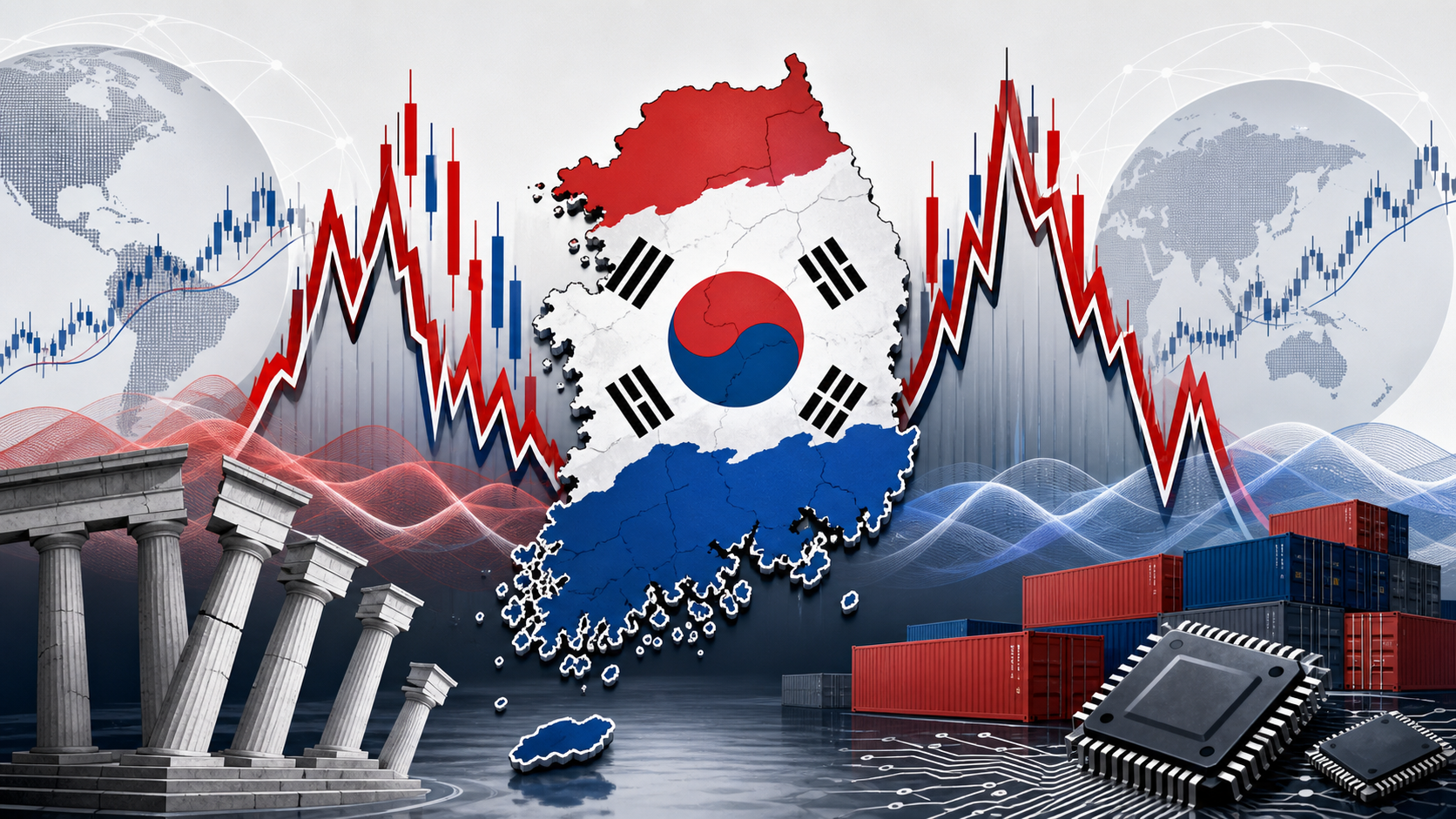
Korea’s stock market has a problem that goes beyond bad luck or global headwinds — it crashes harder, recovers slower, and punishes retail investors more brutally than almost any comparable market. When KOSPI fell nearly 10% in a single session while Taiwan dropped 1.3% and Japan 3.5% on the same day, the question stopped being “what happened?” and started being “why does this keep happening?” Three analysts with very different priors sit down to work through the structural reality underneath the headlines.
Let’s start with the observable fact and ask the question nobody is asking loudly enough. KOSPI shed close to 10% in a single session. Same global shock. Taiwan: 1.3%. Japan: 3.5%. The surface explanation — “Korea has semiconductor exposure” — is true but deeply insufficient. Japan has semiconductor exposure too. Taiwan is built on semiconductors. So why does Korea bleed out while the others absorb the blow?
The answer is concentration risk of a kind that has no real peer in developed markets. Samsung Electronics and SK Hynix together represent roughly 57% of KOSPI market capitalization. Add in the proxy names — Samsung Electronics preferred shares, SK Square, Samsung Life, Samsung C&T — and you’re looking at over 60% of the index moving on what is essentially a two-factor bet: global memory demand and the dollar. When foreign institutional money decides to reduce semiconductor exposure in a risk-off session, they don’t rotate within Korea. They exit Korea. The index doesn’t bend — it breaks.
What concerns me beyond the immediate volatility is the structural KRW dynamic underneath it. The won/dollar rate recently touched 1,550, levels not seen in twenty years — higher in nominal terms than during the 2008 financial crisis. And yet the market commentary treats this as background noise, an acceptable cost of doing business with foreign capital. It is not background noise. A currency at crisis-era levels during a period of record semiconductor exports is a signal that something in the institutional flow architecture is deeply broken. The investor implication is straightforward: until Korea’s index concentration is addressed by structural reform — not jawboning, not government buy programs — every global risk-off event will continue to extract disproportionate punishment from Korean equity holders.
The Macro Bear is right about concentration, but I want to anchor the argument in specifics, because the numbers are more alarming than the narrative. Samsung Electronics and SK Hynix at 57% of KOSPI is not a market — it’s a leveraged single-sector bet with an index wrapper around it. Compare that to Japan, where Kioxia sits at the top with roughly 4.2% weight. Kioxia falling 10% moves the Nikkei by less than half a percentage point. Samsung Electronics falling 10% moves the KOSPI by somewhere between 3 and 5 percentage points before you account for the cascade through correlated names.
Now overlay the leverage structure. Customer deposit balances in Korean brokerage accounts reached 110 trillion won. Margin loan balances hit 32 trillion won. The government then approved leveraged ETFs on Samsung Electronics and SK Hynix — essentially a 2x multiplier on the two names that already constitute the market’s structural vulnerability. The bull thesis for these products was retail participation and exchange rate stabilization via attracting foreign inflows. Fine. But the risk inventory was obvious: you are adding forced-selling mechanics to a market that already has insufficient shock absorbers. When the primary names correct, the leveraged ETF holders don’t get to wait — they get liquidated. That forced selling amplifies the initial move, which triggers more liquidations, which is precisely the waterfall dynamic we observed.
I’ll state the risk I think is most underpriced: the AI infrastructure cycle may be compressing faster than consensus expects. The IBK Securities research note flagging August-September as a potential inflection point for market volatility wasn’t wrong in direction. Leading economic indicator cycles, AI capex pacing by hyperscalers, and Fed rate path uncertainty all converge on the same window. Korea’s index will be the most exposed market to that repricing, structurally, until the concentration problem is fixed. That’s not a trading call. That’s a cycle position assessment.
Let me drill one layer below the concentration argument, because while the 57% figure is real and important, it obscures a mechanism that I think is the actual operative cause of the volatility asymmetry.
The issue isn’t just that two stocks dominate the index. The issue is who holds them and under what mandate. Foreign institutional ownership in Samsung and SK Hynix is heavily skewed toward global funds that run rules-based rebalancing — when equities outperform bonds over a quarter, they must sell equities to restore target allocation ratios. JP Morgan estimated that global institutions needed to execute approximately $165 billion in equity sales following Q2’s bond-equity divergence. Where does that selling concentrate? In the names that outperformed most. Korea’s top two names fit that description precisely. This isn’t panic selling or fundamental reassessment — it’s mechanical, mandatory, and size-insensitive. The Korean market doesn’t have the depth to absorb that flow without violent price dislocation.
Now compare this to Japan. Japan’s foreign ownership profile is distributed across a much wider set of names and sectors — automakers, industrials, financials, consumer goods. No single sector absorbs the totality of a rebalancing wave. The volatility is distributed. In Korea, it concentrates. This is a structural problem that has a name: index architecture dysfunction. And it’s been worsened, not improved, by policy choices. Approving leveraged ETFs on the two most concentrated names in the index adds pro-cyclical volume at exactly the wrong moment. I’m not going to pretend I know whether KOSPI at current levels is cheap or expensive — that depends on variables I’d hold open. But the volatility premium embedded in Korean equities is real, structural, and larger than most international benchmarks would justify. Any honest comparison to Taiwan or Japan on a volatility-adjusted return basis should make Korean equity allocators uncomfortable.
The foreign individual investor access reform — the IBKR-style direct participation channel — could eventually change the ownership distribution in a constructive way. Global retail money flowing into Korean mid-caps and value discount names would diversify the demand base. But that is a multi-year story, and it doesn’t address the immediate architecture problem at the top of the index.
Three analysts, three entry points, one convergent diagnosis. Korea’s extreme stock market volatility is not primarily a sentiment problem, a retail behavior problem, or even a global macro problem — it is a structural architecture problem with three compounding layers: an index with 57%-plus concentration in two memory semiconductor names, a leverage product ecosystem that amplifies forced selling precisely when the market is most fragile, and a foreign institutional ownership pattern that generates mechanical, size-insensitive selling during global rebalancing events. The KRW weakness adds a fourth layer, making every episode more costly for domestic holders than the price decline alone suggests. Reform exists — the Korea Discount reduction agenda, foreign individual access, shareholder return improvements — but those are slow-moving structural corrections, and the next global risk-off event will arrive before any of them are complete.