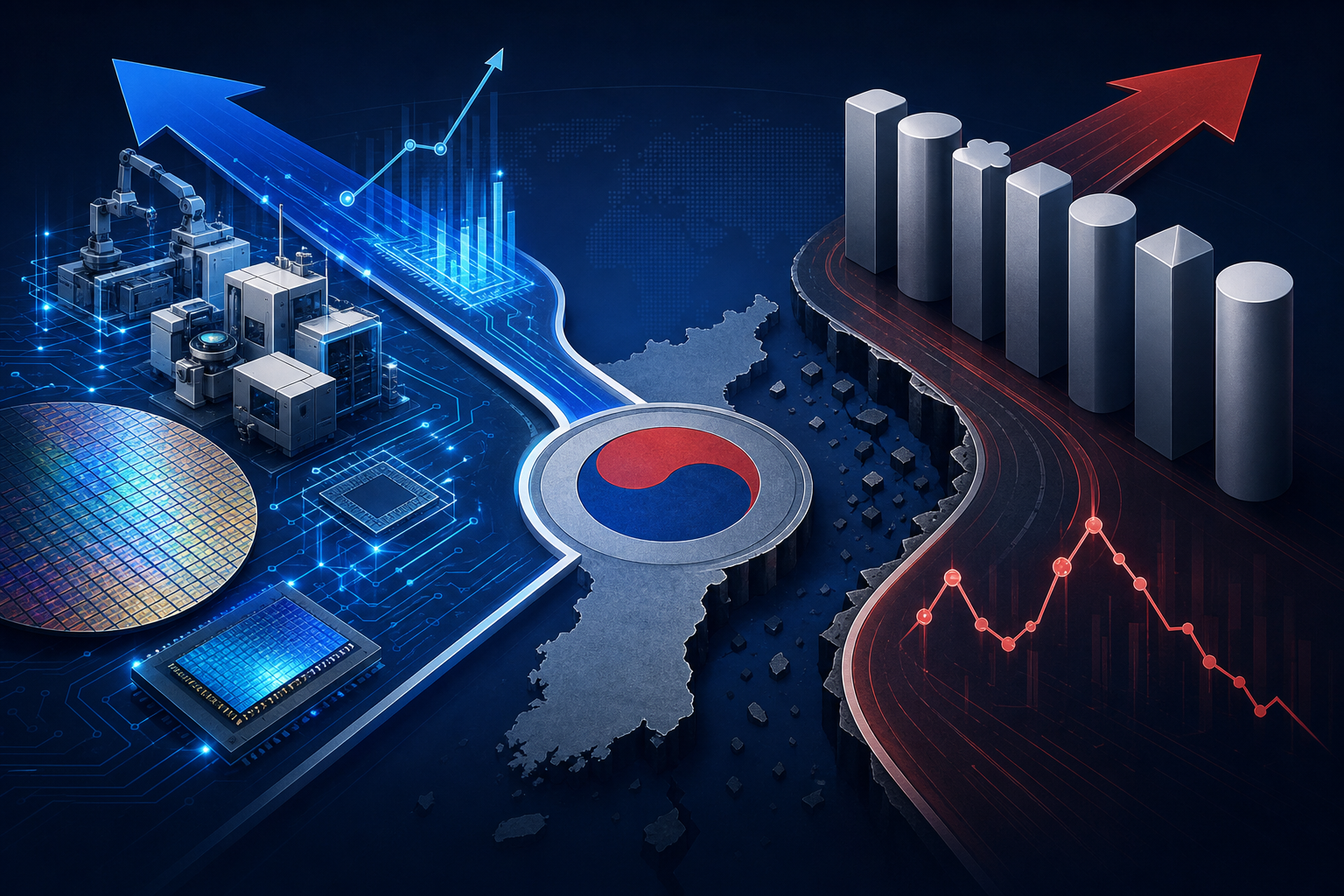
- Tech is up ~28% in H1 2026, but the leadership has rotated sharply away from Mag-7 toward hardware
- Korea’s June semiconductor exports hit ₩448B, crossing 44% of total exports for the first time
- SK Hynix’s 14-year HBM bet is now paying off — it has surpassed Samsung in market cap
- Micron just posted 80%+ operating margins, pulling memory into confirmed mega-cycle territory
- Single-stock leverage ETFs and extreme index concentration are creating new structural fragility in Korean equities
Tech sector up 28% H1. But strip out the semis — what’s Mag-7 actually doing?
Underperforming. The hardware is carrying the whole sector narrative right now.
Samsung and SK Hynix alone are 57% of KOSPI. That’s not a market. That’s a pair trade.
Exactly. And nobody’s asking why Mag-7 is in the penalty box while chips run.
I’ll ask it: capex credibility. Markets don’t believe the AI ROI story anymore.
Right. “We have spare AI capacity” is not a bullish signal. It’s a demand confession.
But memory doesn’t care about the software ROI debate. It cares about HBM order books.
Micron’s 80.4% operating margin last quarter is your order book. That’s not hype, that’s cash.
For now. Someone show me where incremental HBM demand comes from if hyperscaler capex stalls.
Fair concern. But SK Hynix locking in Nvidia supply chain before Samsung even cleared QC — that’s structural, not cyclical.
Samsung’s HBM4 is reportedly entering mass production now. Supply competition is coming.
Which is why you watch pricing, not production headlines.
1996. Micron fell 81% after a single DRAM price cycle turned. Same anatomy.
Different structure. HBM isn’t commodity DRAM. Switching costs are real.
Every cycle says “this time the product is different.” Pricing is still the arbiter.
Agreed. And right now pricing is still moving up. I’ll worry when it doesn’t.
The concentration risk is the underappreciated angle. A single leveraged ETF is materially moving SK Hynix’s daily tape.
That’s the KRW and KOSPI fragility story in one sentence. Structural, not noise.
Korea and Taiwan ETFs now outflow China-focused EM funds. Foreign positioning is stretched too.
So we have: leverage ETF tail risk, 44% export concentration, and EM funds all in the same trade. That’s crowded.
The supply chain angle adds another layer — China’s tungsten powder controls hit Japanese fabs, which feeds back into Korean chipmakers’ input costs.
Real risk, but manageable near term. The cycle is the primary signal, not geopolitics.
PCB substrate makers are lagging Korean semis despite identical fundamental direction. That’s your value pocket if you believe the cycle.
Advanced packaging is the actual bottleneck, not chips themselves. Substrates follow that logic.
Investor implication: semiconductors are real, but the index is not the trade.
The Mag-7 versus semiconductor divergence is not a rotation anomaly — it is a structural repricing of where genuine AI infrastructure scarcity actually lives. Software platform multiples are being questioned because hyperscaler ROI remains unproven; meanwhile, HBM and advanced memory are printing real earnings, with Micron’s 80%+ operating margins and Korea’s record semiconductor export share of 44% providing hard evidence of cycle strength. The bear case is not that the hardware story is wrong, but that extreme concentration — Samsung and SK Hynix representing over half of KOSPI, single-name leverage ETFs distorting daily price discovery, and foreign EM funds crowding into the same Korea-Taiwan AI trade — creates a fragility that has nothing to do with fundamentals. The 1996 Micron parallel deserves respect: memory cycles turn fast, and the trigger is usually pricing, not demand headlines. The pragmatic read is to stay close to the cycle’s real bottlenecks — advanced packaging, substrates, HBM yield curves — rather than chasing index-level exposure to a market that is, increasingly, just two stocks with leverage on top.