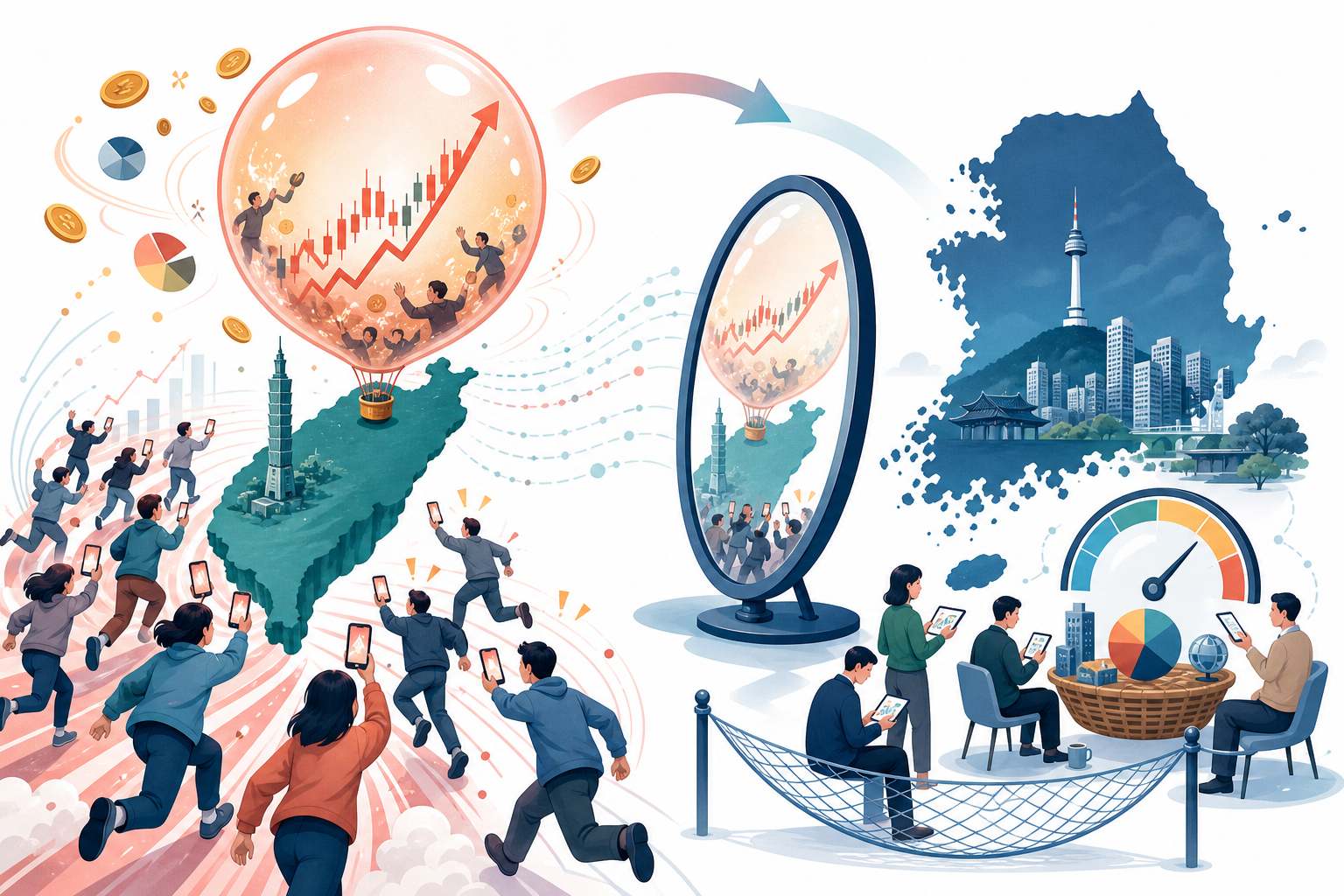
Taiwan’s stock market has become one of the most compelling cautionary tales in global finance — a 100% rally driven partly by debt-fueled retail investors chasing AI-adjacent semiconductor names, with a 26-year-old unemployed man borrowing heavily to ride TSMC-linked momentum now serving as the Bloomberg poster child for the phenomenon. As KOSPI quietly breaks 8,000 and then 9,000, with Samsung and SK Hynix leveraged ETFs flying off the shelf and customer deposit accounts swelling past ₩110 trillion, the question is unavoidable: is Korea writing the same story with a different cast? We asked our three analysts to weigh in.
Start with the observable fact and then ask why it’s happening. Taiwan’s retail investors borrowed aggressively to buy into a semiconductor rally that was, at its core, a legitimate demand story — TSMC’s role in AI inference infrastructure is real. Korea’s current rally has the same surface logic: HBM demand, AI capex guidance from the hyperscalers, Samsung and Hynix as the only scaled suppliers of the memory stacks that make large language models run. So far, so defensible.
But here is what nobody is talking about. The institutional mechanics underpinning this Korean rally are creating forced, recursive buying that has almost nothing to do with fundamental reassessment. Fund managers are legally constrained to hold no more than 10% of AUM in a single name — except that the Korea Financial Investment Association updates eligible concentration limits monthly based on the prior three months’ average market cap weighting. As Samsung and Hynix appreciate, the cap rises, and funds mechanically buy more at month-open. New leveraged ETFs on both names were approved and listed, generating synthetic demand for the underlying cash equities and futures simultaneously. The index goes up. The cap goes up. Funds buy. The ETF creates more demand. This is not price discovery. This is a feedback loop dressed in the clothing of a bull market.
Taiwan’s mistake was not that retail investors had FOMO. FOMO is a human constant. The mistake was that the market structure — cheap margin, liquid single-stock futures, no circuit-breaker culture — allowed that FOMO to be expressed with unlimited leverage against a concentrated set of names. Korea’s structure is now replicating that configuration in near-perfect detail. Customer margin credit stands at ₩32 trillion. The investor implication is straightforward: when the unwind comes, and it will come on any material guidance miss from a hyperscaler, the Korean exit door will be narrower than anyone currently believes.
Let me state the bull thesis first, because intellectual honesty requires it. The AI-driven memory upgrade cycle is structurally different from prior DRAM supercycles in one important way: the demand source has shifted from consumer end-devices — which are inherently cyclical and price-elastic — toward datacenter infrastructure buildout, which is driven by hyperscaler capex commitments that are multi-year and relatively sticky. Big Tech’s aggregate AI capex guidance has been revised upward in every successive earnings season. That is a real tailwind, and dismissing it entirely is its own form of analytical error.
That said, let me map where we sit in the cycle, because valuation without cycle context is decoration. The 1996 Micron collapse — an 81% drawdown — was preceded by a period where DRAM spot prices had risen so far that customers began deferring orders and working down inventory rather than replenishing at peak prices. The mechanism was identical to what we see in every semiconductor upcycle: price increases initially pull forward demand, then suppress it. Samsung Electronics and SK Hynix are now trading at multiples that embed continued HBM ASP expansion and volume growth simultaneously. The ordinary share-to-preferred share discount on Samsung has reached 27%, versus a historical range of 5–20%. That spread is a sentiment indicator, not a fundamental one. When sentiment instruments are trading at historical extremes, cycle-aware investors should be reducing, not adding.
The Taiwan comparison is instructive precisely because the underlying thesis there was also correct — TSMC genuinely is the most critical node in global AI infrastructure. The error was not the thesis; it was paying thesis-perfect prices and then financing the position with borrowed money. A 26-year-old with no income and a leveraged semiconductor position is not an outlier data point. He is the marginal buyer that price-discovery requires you to worry about. When the marginal buyer is credit-constrained and thesis-dependent, the correction will not be gentle.
Here is the drill-one-layer-below move that the Taiwan narrative keeps missing. The FOMO bubble framing treats this as primarily a behavioral story — retail investors acting irrationally under the influence of social proof and cheap credit. That is partly true. But the more important structural fact is concentration risk, and Korea makes Taiwan look diversified by comparison.
Run the benchmark. In Taiwan, TSMC dominates but represents roughly 30% of the TAIEX by weight. Japan’s Kioxia, after its recent relisting surge to market cap leadership, sits at approximately 4.2% of the Nikkei. Korea? Samsung Electronics and SK Hynix combined represent 57% of KOSPI market cap. Add the proxy holdings — Samsung preferreds, Samsung Life, Samsung C&T, SK Square — and you are north of 60% of the index effectively moving on the fortunes of two memory companies. When Korea sold off hard on a single session that saw Taiwan drop 1.3% and the Nikkei fall 3.5%, Korea printed a 9.9% decline. That is not behavioral excess. That is structural amplification. The same global signal produces a three-to-seven times larger output in Seoul because the concentration factor is extreme.
Now layer the leverage on top. The government approved leveraged ETFs on Samsung and Hynix at what any honest reading of the data would identify as a late-cycle sentiment extreme — customer deposits at ₩110 trillion, margin credit at ₩32 trillion, the Korea National Growth Fund selling out within two weeks of launch targeting retail investors earning under ₩50 million annually. I will hold the uncertainty openly here: I do not know when this corrects, and I distrust anyone who claims to. What I do know is that when foreign institutions and domestic funds both trigger simultaneous selling — which we have now seen with foreign net selling of ₩6.2 trillion and institutional selling of ₩5.7 trillion in a single session — retail investors are left as the sole absorber of supply. That is not a FOMO story. That is a market microstructure failure that policy made worse.
All three analysts converge on a discomforting conclusion: the Taiwan FOMO bubble and the current Korean market share not just superficial resemblance but identical structural DNA — concentrated index exposure, leverage amplification, retail investors as the buyer of last resort, and a legitimate underlying thesis (AI semiconductor demand) being used to justify prices that have already priced in the best-case outcome. Where they diverge is on emphasis: the Macro Bear sees the institutional flow mechanics as the primary risk, the Value Hunter anchors concern in cycle positioning and historical valuation extremes, and the Street Pragmatist insists the concentration structure is the variable that turns a normal correction into a systemic event. The uncomfortable synthesis is that all three risk vectors are present simultaneously — and Taiwan’s story suggests that when they interact, the result is not a gentle repricing of enthusiasm but a rapid, disorderly unwind that catches even the skeptics shorter than they planned to be.