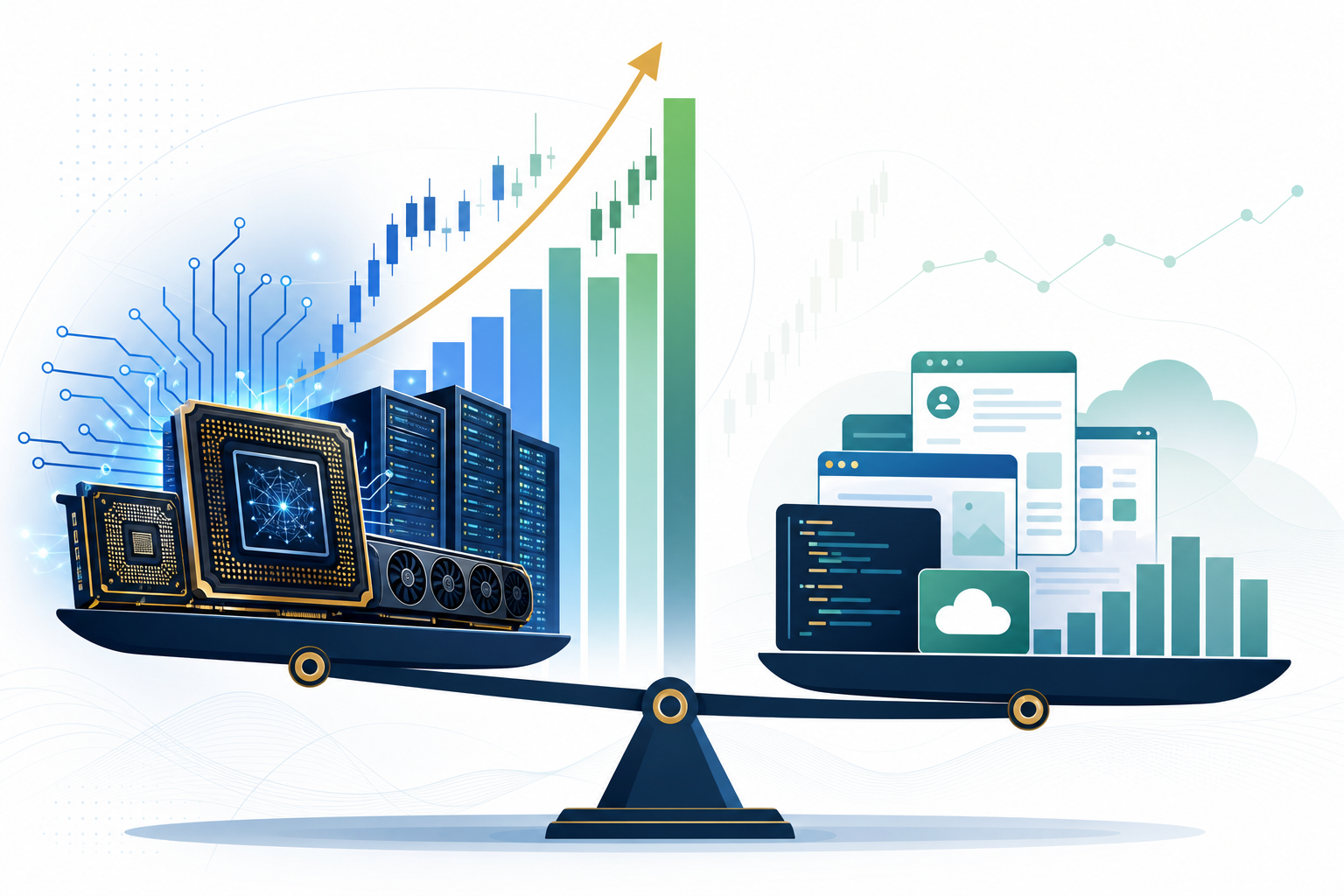
The great valuation debate of 2025 has a new battleground: AI semiconductor companies versus traditional software firms. With Nvidia’s market cap eclipsing the entire GDP of India, SK Hynix surpassing Samsung in market value on the back of HBM dominance, and Big Tech’s collective AI bill running into the trillions, investors are asking a fundamental question — are AI chip valuations a rational re-pricing of the future, or a speculative mania dressed up in silicon? We put the question to our three analysts, and as usual, they didn’t agree on much.
Let me start with a number that should unsettle anyone who has been riding the AI semiconductor wave with uncritical enthusiasm. In a single month last year, the combined market capitalization of the Magnificent 7, Broadcom, and Oracle shed roughly $2.7 trillion in value. That wasn’t noise. That was the market beginning — just beginning — to ask whether the AI infrastructure spending binge would ever convert into proportional returns. The answer, so far, is deeply unclear.
Nvidia’s ascent to a $5 trillion-plus market cap is a genuine marvel of financial history. I won’t deny the engineering achievement. But when a single company is valued above the entire economic output of a nation of 1.4 billion people, you are no longer in the territory of valuation — you are in the territory of faith. And faith-based markets have a well-documented tendency to revert. The macro backdrop makes this worse: global liquidity conditions are tightening at the margins, and the AI capex cycle is creating enormous balance sheet stress for the hyperscalers funding it. When the capital spigot tightens, the first assets to reprice are the most speculative ones. AI semiconductor stocks, trading at multiples that assume a decade of flawless execution, are squarely in that category.
Meanwhile, Google’s TurboQuant paper — a memory efficiency technique that caused immediate single-day drops in shares of Samsung Electronics and SK Hynix — illustrates precisely the kind of technological discontinuity risk that doesn’t appear in a discounted cash flow model. The entire HBM premium is predicated on the assumption that AI model architectures will remain memory-hungry indefinitely. What happens to SK Hynix’s valuation story if memory efficiency innovations reduce that dependency? Traditional software companies — your enterprise SaaS, your ERP vendors — don’t carry that kind of existential architectural risk. They’re boring. But boring survives.
With respect to my colleague’s macro hand-wringing, let me offer something more useful: actual numbers. In Q1 2026, the operating profit gap between the top three memory companies and the top three CPU companies was nearly nine times — in favor of memory. Nine times. And yet if you look at market capitalization, the gap between those two groups is essentially negligible. The market is pricing CPU and memory companies at roughly comparable valuations despite a nearly order-of-magnitude difference in current earnings power. That is a valuation anomaly worth paying attention to, regardless of which direction you think it corrects.
SK Hynix’s 14-year transformation from a struggling acquisition target into the world’s most valuable Korean company is not a story about hype — it’s a story about disciplined capital allocation into a niche technology that the market didn’t fully understand. When SK Group acquired Hynix in 2012, the deal was widely criticized. The bet on High Bandwidth Memory was made years before the AI supercycle validated it. That is what intelligent fundamental investing looks like: identifying structural advantages before the crowd prices them in. The advanced packaging bottleneck — the constraint that no one talks about because it’s less glamorous than GPU specs — is the next version of that story. Companies operating in advanced packaging for AI servers are sitting on structural pricing power that the market has not yet fully recognized.
As for traditional software firms, the value case is more nuanced than the AI bears admit. Enterprise software companies with deep integration into corporate workflows have genuine moats — high switching costs, recurring revenue, and meaningful free cash flow generation. The question isn’t whether they’re better or worse than semiconductor companies in the abstract; it’s whether you’re paying a rational price for what you’re getting. Right now, several traditional software names are trading at multiples that reflect AI disruption fear rather than fundamental impairment. That’s where I’m looking. Fear-driven discounts in quality businesses are a gift. I’ll take the gift.
Look, I appreciate the macro framework and I respect the balance sheet discipline, but let me tell you what the market is actually doing right now, because theory and practice are having a significant disagreement. The Q1 2026 earnings season was unambiguous: AI demand is not slowing down. The hyperscalers confirmed it. SK Hynix and Micron confirmed it. The numbers are real. Revenue is real. Operating margins at the leading HBM suppliers are real. You can argue about whether valuations are extended — they probably are — but betting against a cycle that is still accelerating in the earnings data is a trade that has crushed a lot of smart people over the past two years.
The more interesting tactical call right now is within the semiconductor complex itself, not between semiconductors and software. Memory versus logic, advanced packaging versus finished chips, HBM versus NAND — these distinctions matter enormously for near-term returns. SemiAnalysis flagged the bottleneck rotation clearly: the constraint is shifting from GPU availability to power infrastructure to packaging and memory. That means the next leg of outperformance within AI semis may not be Nvidia — it may be the upstream suppliers that nobody is writing breathless articles about. In Korea specifically, the advanced packaging ecosystem is massively underfollowed relative to its strategic importance. That’s where I’m positioned.
On traditional software: the street has already largely moved on. The narrative has shifted to AI-native applications and away from legacy SaaS. That doesn’t mean the fundamentals have deteriorated — many of these businesses are fine — but narrative drives flows, and flows drive prices in the medium term. If you’re running a traditional software position right now, you need a very clear catalyst to get re-rated, because the default mode for that sector is being ignored while capital chases the AI infrastructure theme. Ignored and cheap can work, but you need patience that most institutional money doesn’t have.
The debate over AI semiconductor valuations versus traditional software ultimately comes down to time horizon and risk tolerance, and our three analysts reflect that divide cleanly. The Macro Bear is right that the scale of AI capital expenditure creates systemic risk and that technological disruption — as illustrated by memory-efficiency innovations — can reprice entire sectors overnight. The Value Hunter is right that earnings fundamentals in the leading HBM suppliers are genuinely extraordinary, and that fear-driven discounts in quality software businesses deserve a closer look. And the Street Pragmatist is right that the near-term trade is less about semiconductors versus software and more about identifying the next bottleneck within the AI supply chain before the market does. The honest answer is that both AI chips and traditional software contain pockets of genuine value and genuine excess — and the work, as always, is in telling them apart.