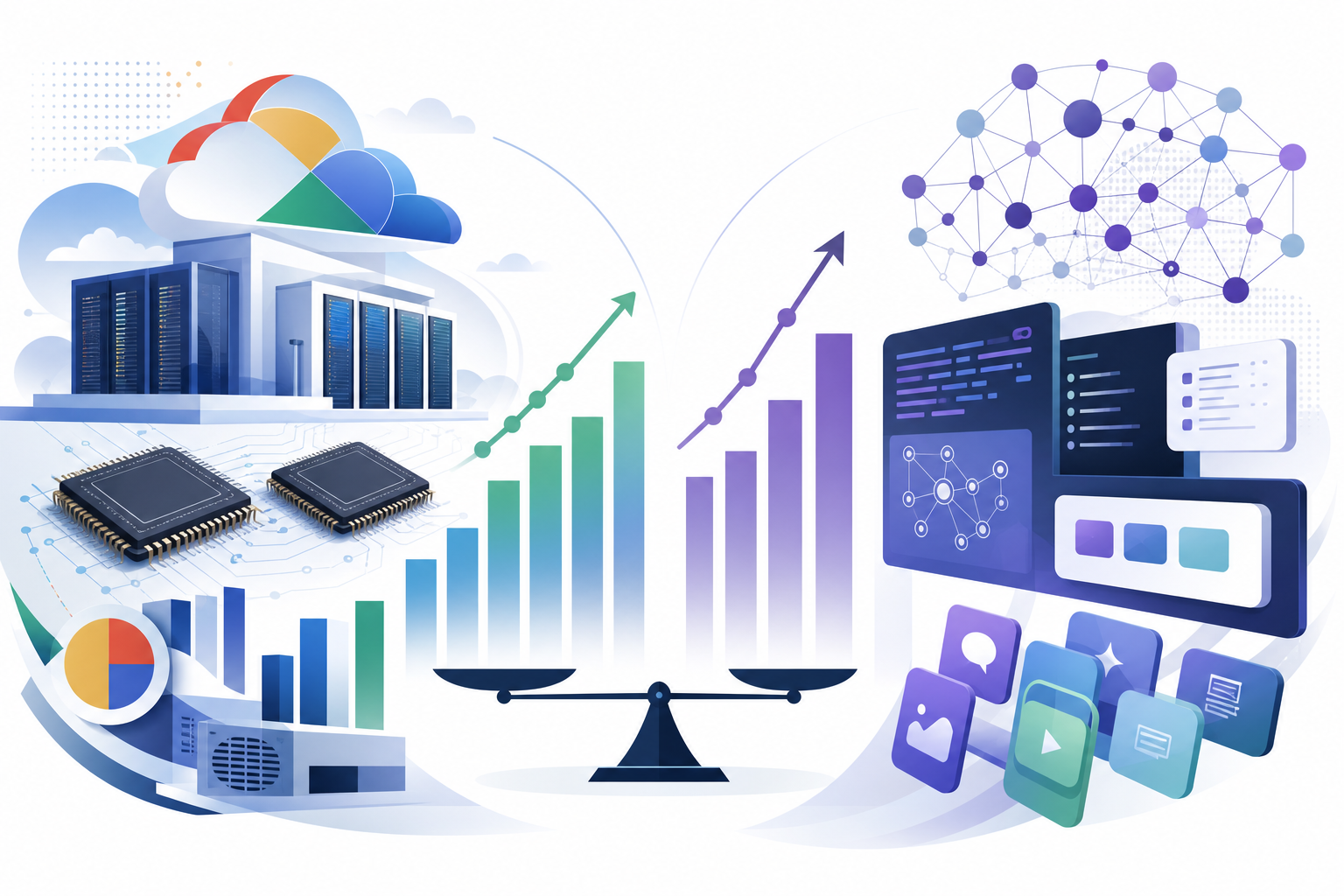
The AI investment supercycle is entering a new, more complicated phase — one where blowout cloud earnings coexist with trillion-dollar capital raises, and where chip stocks like AMD and Qualcomm are surging even as software firms scramble to justify their valuations. We brought together our three analysts to untangle what Alphabet’s cloud surprise, AMD and Qualcomm’s quarterly results, and the growing divergence between AI hardware enablers and AI software pure-plays actually mean for investors navigating this landscape.
Let me start with what the bulls keep glossing over. The same quarter that produced Alphabet’s eye-catching cloud growth numbers also produced one of the largest equity issuances in American corporate history. Alphabet raised $84.75 billion in a single capital raise — more than SpaceX is seeking in its entire IPO. Meta is reportedly considering following suit. Google, a company generating roughly $174 billion in annual operating cash flow, still needed to go to capital markets. That tells you everything about the scale of the CapEx monster these hyperscalers have created.
The numbers are stark. Big Tech’s combined market cap — the Magnificent 7 plus Broadcom and Oracle — shed approximately $2.7 trillion in a single month earlier this year as investors began asking the obvious question: when does the AI infrastructure spend translate into commensurate returns? Goldman Sachs flagged that free cash flow among major tech firms is near its lowest level since the dot-com bubble. We are watching companies issue $550 billion in bonds, take on leverage at a pace that would make a 2000s-era private equity firm blush, and the market is cheering the revenue line while ignoring the balance sheet deterioration underneath. AMD and Qualcomm posting decent quarters doesn’t change this macro dynamic — it just means the picks-and-shovels trade has more runway before the reckoning arrives.
The deeper concern is what happens when the hyperscaler CapEx cycle peaks. Oracle’s cloud infrastructure, OCI, is accelerating beautifully quarter over quarter — but Oracle’s stock swung violently even on a beat, because the market is increasingly sensitive to forward guidance on capital intensity. When operating cash flow is almost entirely consumed by CapEx, any slowdown in AI monetization creates a very uncomfortable financing gap. I’m not calling a collapse — I’m saying the risk/reward has shifted materially, and anyone treating Alphabet’s cloud beat as unambiguously bullish is ignoring what’s funding it.
With respect to my colleague’s macro theater, let’s look at what the actual numbers say. Alphabet’s quarterly revenue crossed the equivalent of 600 trillion Korean won annualized — comparable to Samsung Electronics’ full-year projected figures. More importantly, operating margins hit above 36% in the quarter, an all-time record. Cloud revenue growth accelerated to nearly 63% year-over-year at scale — this is not a company burning money without return. This is a company whose core business is printing cash while a second, faster-growing business is being built on top of it.
The Alphabet cloud backlog is the number that should be dominating the conversation. The ratio of remaining performance obligations to quarterly cloud revenue now stands at over 13.6 times. That means Alphabet has already sold more than thirteen quarters’ worth of its current cloud run rate in contracted future revenue. Customers are not experimenting with AI cloud workloads — they are committing capital years in advance. That’s the behavioral signal of a secular shift, not a cyclical bump. AMD’s results fit the same narrative: CPU demand is recovering sharply across both enterprise and hyperscaler segments, validating that the AI buildout is broad-based, not concentrated in a single product category.
On the capital raise criticism — yes, Alphabet raised $84.75 billion. The market oversubscribed it to $84.7 billion within 24 hours of announcement. That is not distress financing. That is a company taking advantage of investor appetite to accelerate into a generational infrastructure opportunity at a cost of capital that most businesses could only dream of. The real valuation question is not whether the capital raise is alarming — it’s whether the software firms commanding 15-20x revenue multiples on the assumption that AI will transform their unit economics can actually deliver. That’s where I’d be more cautious.
Look, I don’t want to debate bond markets and free cash flow models when there are clear, actionable signals in these earnings prints. Let me tell you what’s actually moving: cloud is accelerating, CPU is turning around, and the gap between hardware/infrastructure winners and AI software pretenders is widening fast.
Alphabet’s cloud is the standout story. Growth accelerating to nearly 50-63% depending on the quarter you’re looking at, with RPO backlog that keeps growing faster than revenue. AWS is doing almost $37 billion a quarter and still growing close to 30% — at that scale, that’s extraordinary. The demand is not slowing; it’s speeding up. AMD and Qualcomm delivered results that confirm AI compute demand is spreading beyond the hyperscaler tier into enterprise, edge, and even consumer devices. Qualcomm’s AI inference play at the device level is underappreciated. AMD’s CPU comeback alongside its GPU push into data centers gives it optionality that pure-play GPU firms don’t have. Compare the earnings power: CPU companies collectively are still running at nearly nine times lower operating profit than the memory complex, yet the market cap gap is surprisingly narrow — that tells me CPU multiples have room to expand as earnings catch up.
The trade I’d be fading right now is undifferentiated AI software. We’re seeing a clear bifurcation: companies that own the physical infrastructure of AI — cloud, compute, memory, networking — are posting numbers that justify or even understate their multiples. But a lot of AI software firms are trading on narrative and TAM slides rather than revenue acceleration. Google’s Gemini ecosystem is an underappreciated threat here — they control search data, YouTube video data, and now have a model competitive with anything OpenAI offers. The software firms that assumed hyperscalers would stay in the plumbing business are about to learn that Alphabet, Microsoft, and Amazon are perfectly happy to commoditize the application layer too. Play the infrastructure; be very selective on software.
Synthesis: Conviction on Infrastructure, Skepticism on Everything Else
The three perspectives converge on one underlying truth: the AI infrastructure buildout is real, accelerating, and reflected in hard revenue numbers — but the financing required to sustain it is introducing macro risks that the market has not fully priced. Alphabet’s cloud blowout and AMD and Qualcomm’s solid earnings confirm that the hardware and cloud layer of the AI stack remains the highest-conviction trade. The fault line runs beneath the software tier, where lofty valuations rest on execution promises rather than contracted backlog. For investors watching this space from Korea or anywhere else, the question is not whether AI is a real economic force — the numbers have settled that debate — but who captures the value, and whether the capital structure required to win can survive a world of higher-for-longer rates and intensifying competition from hyperscalers moving up the stack.