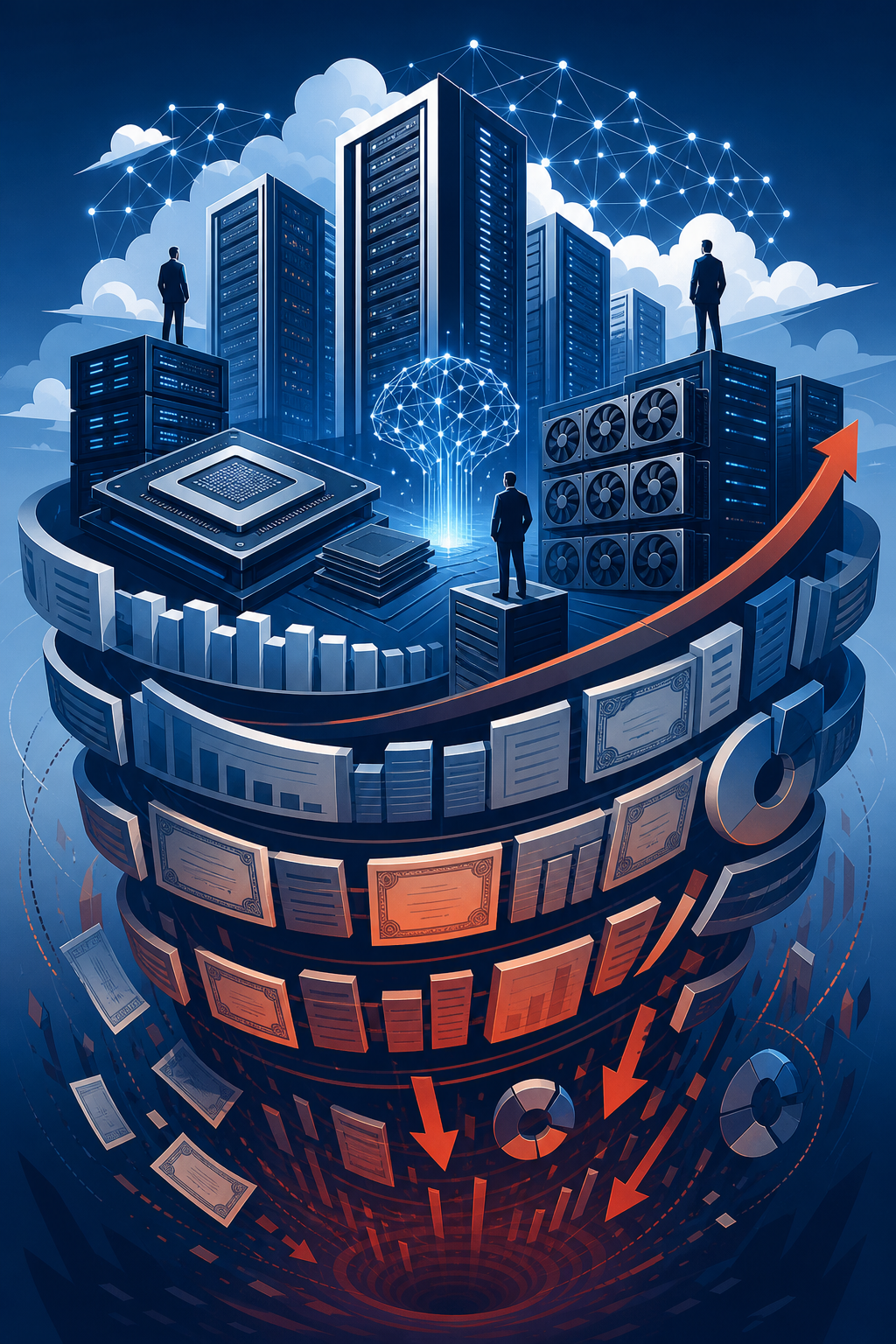
The numbers coming out of Silicon Valley are no longer just large — they are structurally significant in ways that most market commentary is failing to capture. Google’s $84.75 billion equity raise, Meta’s capex guidance approaching $135 billion for 2026, Amazon burning through 94% of its operating cash flow on capital expenditure — these are not isolated data points. They are symptoms of something systemic. We asked three of Korea’s sharpest economic minds to sit down and tell us what they actually see.
Nobody is talking about the right variable here. Everyone is fixated on the AI demand narrative — tokens, inference runs, enterprise adoption curves. Fine. But the mechanism that will determine whether this capex cycle ends in transformation or in tears is the 10-year US Treasury yield, currently sitting at 4.49%. That yield is the discount rate applied to every dollar of AI cash flow that doesn’t arrive until 2028, 2029, or 2030. And right now, those cash flows are being priced as if they are certain.
They are not certain. What is certain is the debt. Goldman Sachs has flagged that free cash flow across the major hyperscalers is at its lowest level since the dot-com era. Let me be precise about what that means institutionally: when FCF collapses, the bond market becomes the marginal funder of your ambitions. Google issued $55 billion in bonds. The five largest hyperscalers — Alphabet, Amazon, Meta, Microsoft, Oracle — have collectively raised or signaled $644 billion in fresh capital this year alone, between equity issuances and corporate bonds. SpaceX raised $75 billion in its IPO and immediately moved to issue another $20 billion in corporate bonds ten days later. The stock fell 16%. The market understood the implication before the analysts finished writing their notes.
Here is the investor implication that nobody wants to say directly: you now have to watch corporate credit spreads as a leading indicator for big tech equity. If investment-grade spreads widen — even modestly — the reflexive logic of “borrow cheap, build fast, monetize later” breaks down. The AI equity bull case is, at its foundation, a leveraged bet on rates staying contained. That is the structural vulnerability. File it under “things that are obvious in retrospect.”
Let me offer a more granular read, because the bear case as stated conflates two very different types of borrower. Amazon’s shareholder letter from April 2026 is worth reading carefully. Management states explicitly that their capex is driven by customer commitments — the OpenAI contract alone exceeds $100 billion. Oracle’s cloud RPO backlog is growing at over 40% year-on-year, and their operating cash flow is actually trending upward even as capex rises. These are not companies borrowing against a hope. They are borrowing against signed contracts. That is a materially different risk profile than the dot-com era, where the underlying demand was speculative.
Now, the risks — and I will list them plainly. First: counterparty concentration. If a meaningful portion of AWS or Google Cloud’s RPO backlog is sourced from AI-native companies that are themselves burning venture capital, then a risk-off episode in private markets creates a cascade. Second: the valuation multiple problem. A company like Oracle is now spending nearly 100% of quarterly revenue on capex. Even if the revenue trajectory justifies it, the market is pricing in a scenario where AI monetization compounds indefinitely. The moment growth decelerates, the multiple compression will be violent. Third: equity dilution is real. Google’s $84.75 billion raise — the largest in US corporate history — is not free. Existing shareholders absorbed dilution. When Meta signals it is considering a similar move, that is a supply signal the equity market needs to price.
Where I land: the leverage itself is not the crisis. The crisis risk comes if AI adoption among enterprise customers plateaus before the debt service burden becomes self-funding. We do not yet have enough data to call that. OpenAI’s API token usage surged from 6 billion per minute in October to 15 billion per minute by March 2026. That is not a demand plateau. But I would want to see at least two more quarters of cloud RPO growth before concluding the debt spiral thesis is wrong.
Here is what I think is actually happening, and why the simple “bubble” frame misses the mechanism. The capex cycle is real, the demand is real, but the financial architecture being constructed around it creates a specific type of systemic risk that is neither priced in equities nor fully understood by credit investors.
Consider the IPO pipeline. SpaceX, OpenAI, Anthropic — three of the largest IPOs in history are potentially hitting the market within months of each other. The conventional concern is supply-demand for equities: too much paper, not enough buyers. That is a shallow read. The deeper mechanism — and IBK Securities in Korea actually flagged this in a recent note — is that historically, mega-IPO events cause corporate bond stress indices to deteriorate sharply in the run-up, as capital that would otherwise flow to the credit markets gets diverted toward IPO subscriptions. Smaller companies with legitimate financing needs get crowded out. Financial conditions tighten at the margin for everyone below the hyperscaler tier. That is a real economy effect, not just a market plumbing issue.
The other thing I want to anchor in specifics: the SoftBank comparison matters here. SoftBank has become Japan’s largest company by market cap on the back of heavily leveraged AI bets. CNBC has raised explicit concerns about the risk profile. The parallel to the hyperscalers is imperfect — SoftBank is a financial intermediary taking on leverage to fund other companies’ AI infrastructure, while the hyperscalers are at least building real assets with real utilization — but the shared logic is the same: you are front-loading enormous financial risk on the assumption that AI monetization compounds fast enough to service the debt. Right now, AAA corporate bond spreads are stable. The credit market is not signaling distress. But stable spreads in a rising-rate environment with $644 billion of new issuance incoming is not comfort — it is complacency. I hold that uncertainty openly: I don’t know if this ends badly. I do know the margin for error has compressed significantly, and most equity narratives are not pricing that compression.
Three analysts, three different entry points, but a convergent concern: the AI capex cycle is not inherently irrational, but the financial superstructure being built around it has introduced leverage risk that operates on a different timeline than the revenue payoff. Signed contracts and surging token usage provide a real demand foundation that the dot-com era lacked entirely. But the combination of rising Treasury yields, record equity issuance, a crowded IPO pipeline, and free cash flow at multi-decade lows means the system has less shock absorption than the headline narratives suggest. Watch credit spreads. Watch cloud RPO growth. And watch what happens when SpaceX, OpenAI, and Anthropic all hit the tape at once — because the bond market will have something to say about it, and it will not be quiet.