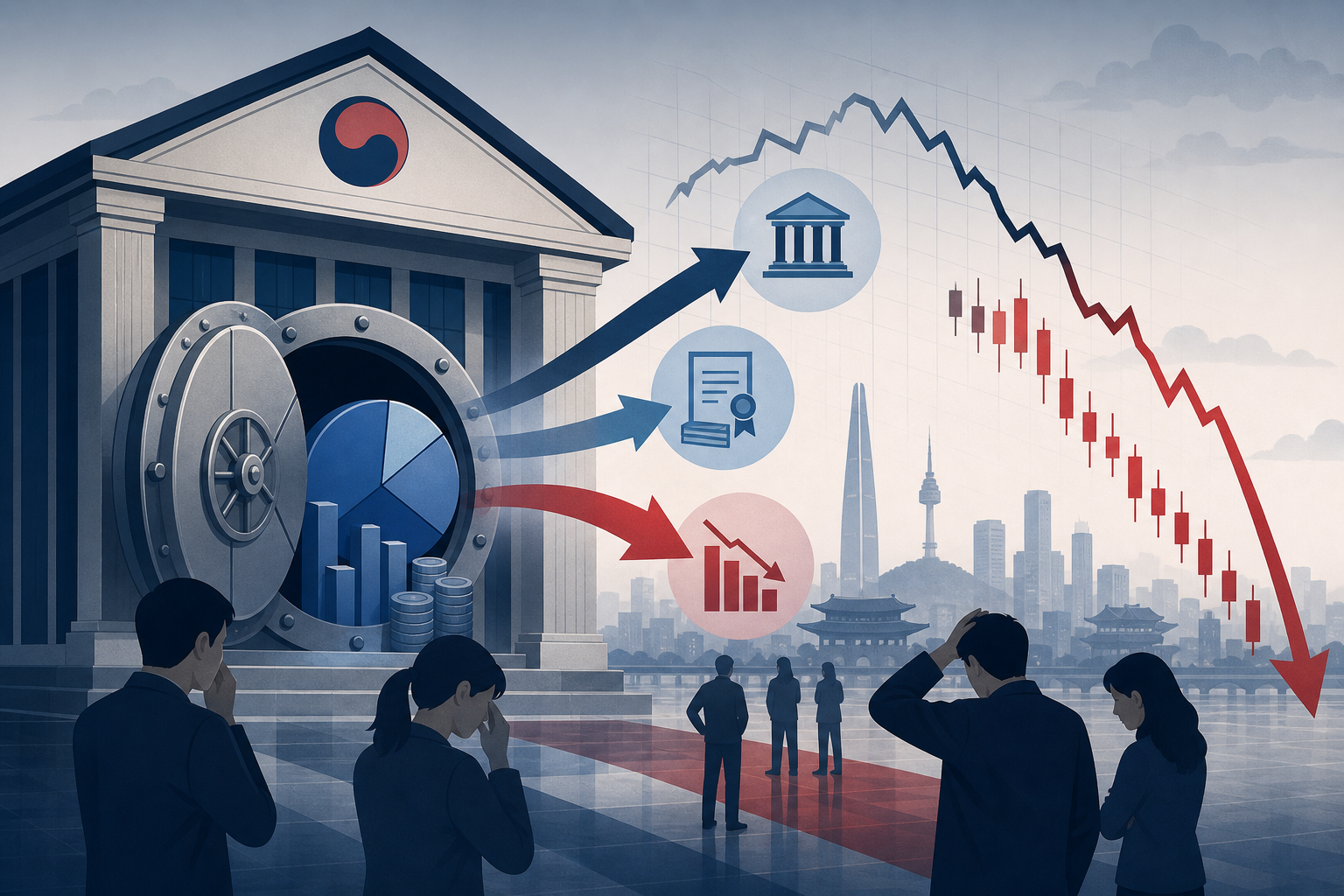
The KOSPI’s dramatic sell-off in late June 2026 — a single-day collapse of nearly 10%, the fifth-largest decline in the index’s history — sent shockwaves through Korean markets and triggered circuit breakers that halted trading entirely. Foreigners dumped ₩6.2 trillion in a single session, institutions added another ₩5.6 trillion in net selling, and retail investors were left holding the bag. Three analysts weigh in on what actually happened, and what it means for anyone still holding Korean equities.
Everyone is pointing at the National Pension Service rebalancing as the cause. That’s the surface explanation. The real question is: why did a mechanical, predictable portfolio adjustment produce a near-historic market dislocation?
Start with the arithmetic. The NPS holds somewhere north of ₩500 trillion in domestic equities. Its target allocation for Korean stocks sits around ₩300 trillion. After the KOSPI’s extraordinary rally — at one point crossing 9,000 for the first time in history — the NPS’s actual domestic equity exposure ballooned well above its target band. The rebalancing math isn’t complicated: you’re talking about a potential sell order in the range of ₩200 trillion in notional excess exposure. Even if they execute that over months, the market knowing it’s coming is itself destabilizing. This is the same dynamic we saw in 2021 when NPS rebalancing was suspended — and the market gyrated on that announcement alone. Five years later, same script.
But nobody is talking about what made this particularly lethal this cycle. Global passive funds and MSCI/FTSE-tracking ETFs also ran into the same problem simultaneously. JP Morgan estimated global institutional equity sales of roughly $165 billion for Q2 rebalancing — and when stocks have outperformed bonds as aggressively as they did in Q2 2026, the math forces equity reduction across every fund with a target allocation. When the NPS and global passives are all forced sellers at the same moment in the same concentrated market, you don’t get orderly price discovery. You get a cascade. The investor implication is direct: this wasn’t a one-day aberration. Until NPS clarifies its rebalancing timeline and execution strategy, any rally in Korean large-caps is a selling opportunity for institutional accounts with liquidity constraints.
Let me state the bull case first: the KOSPI’s rally to 9,000 was underwritten by genuine earnings momentum in semiconductors, AI infrastructure demand for HBM, and a real — if uneven — improvement in Korea discount reform. Samsung Electronics and SK Hynix together briefly accounted for over 57% of KOSPI market cap. The Samsung and SK group listed entities combined crossed ₩5,117 trillion in market cap. Those are real numbers representing real earnings power.
Now the risks, which the market chose to ignore until it couldn’t. First: concentration. When two stocks are 57% of your index, the index is not a market — it’s a leveraged bet on the memory cycle. History is instructive here. Micron Technology fell 81% between 1995 and 1996 when DRAM prices collapsed after a demand-driven price surge caused customers to pull forward orders and then cancel them. The mechanism: price rises so fast that buyers overbuy, then abruptly cut orders when inventory builds. That pattern is visible again in the current cycle — semiconductor analysts are beginning to publish cautionary notes on forward demand, and the Micron earnings report overhang was itself a source of position-trimming pressure in the days before the crash. Second: the NPS rebalancing halt is not just a technical issue. It signals something more uncomfortable — the pension fund effectively became a reluctant buyer on the way up and is now a structural seller. The 2021 precedent, when the last rebalancing pause occurred, resolved with significant market volatility. Third: single-name leveraged ETFs on Samsung and Hynix amplified every directional move. A 12% decline in Samsung translated to a 24-26% loss in the levered product. These instruments don’t add liquidity — they destroy it on the way down. At current valuations, I’d want to see KOSPI PBR settle back toward 1.0x before treating this as a structural buy rather than a dead-cat bounce.
Let’s drill one layer below the consensus narrative. The NPS rebalancing story is real, but it’s being used as a convenient villain for a problem that was structural and entirely foreseeable. The actual question is: why does the same global shock produce a 9.9% drop in Korea, a 3.5% drop in Japan, and a 1.3% drop in Taiwan? All three markets have heavy semiconductor exposure. The answer isn’t the NPS. The answer is concentration plus leverage plus thin institutional depth.
Here’s the mechanism. Korea’s top two stocks — Samsung Electronics and SK Hynix — hold a combined free-float weight that dwarfs any comparable concentration in developed or EM peers. Japan’s largest stock, Kioxia, accounts for roughly 4.2% of the Nikkei. A 10% decline in Kioxia barely registers at the index level. In Korea, a 12% decline in Samsung and Hynix is a systemic event by definition. Layer on top of that the government-encouraged proliferation of single-stock leveraged ETFs — products that must buy more when prices rise and sell more when prices fall, mechanically amplifying every directional move in exactly the two stocks that already dominate the index. This isn’t volatility that emerged from nowhere. It was engineered.
The international benchmark tells the story clearly. Taiwan’s TSMC is arguably more dominant in its sector than Samsung is in memory, yet Taiwan didn’t experience a circuit-breaker event. The difference is that Taiwan doesn’t run 2x daily-rebalancing leveraged ETFs on TSMC. Korea does. And the foreign investor rebalancing — the ₩120 trillion in net selling by foreigners over the year — isn’t “Korea exit.” It’s mechanical MSCI weight adjustment as Korean equity weight within the index grew faster than global passives could absorb. That’s a success problem masquerading as a crisis. I’ll hold my conclusion here, because the honest answer is we don’t yet know whether the NPS will resume rebalancing, how quickly, or whether the government will intervene again. What I’m confident in: any analyst who tells you they have a clean price target on the KOSPI right now is working with less information than they’re admitting.
What June 2026’s KOSPI crash actually demonstrated is a market whose extraordinary rally created the precise conditions for its own unraveling. The NPS rebalancing wasn’t a surprise — it was a known mechanical consequence of a pension fund whose domestic equity exposure had grown ₩200 trillion beyond its target weight. Global passive funds faced the same forced-selling math simultaneously. And a market where two stocks account for nearly 60% of capitalization, amplified by leveraged ETFs that mechanically chase momentum in both directions, had no shock absorbers left when institutional sellers arrived at the same door at the same time. The three analysts disagree on emphasis — structural design, valuation hubris, or flow mechanics — but agree on one thing: the architecture that produced this crash is still fully intact.