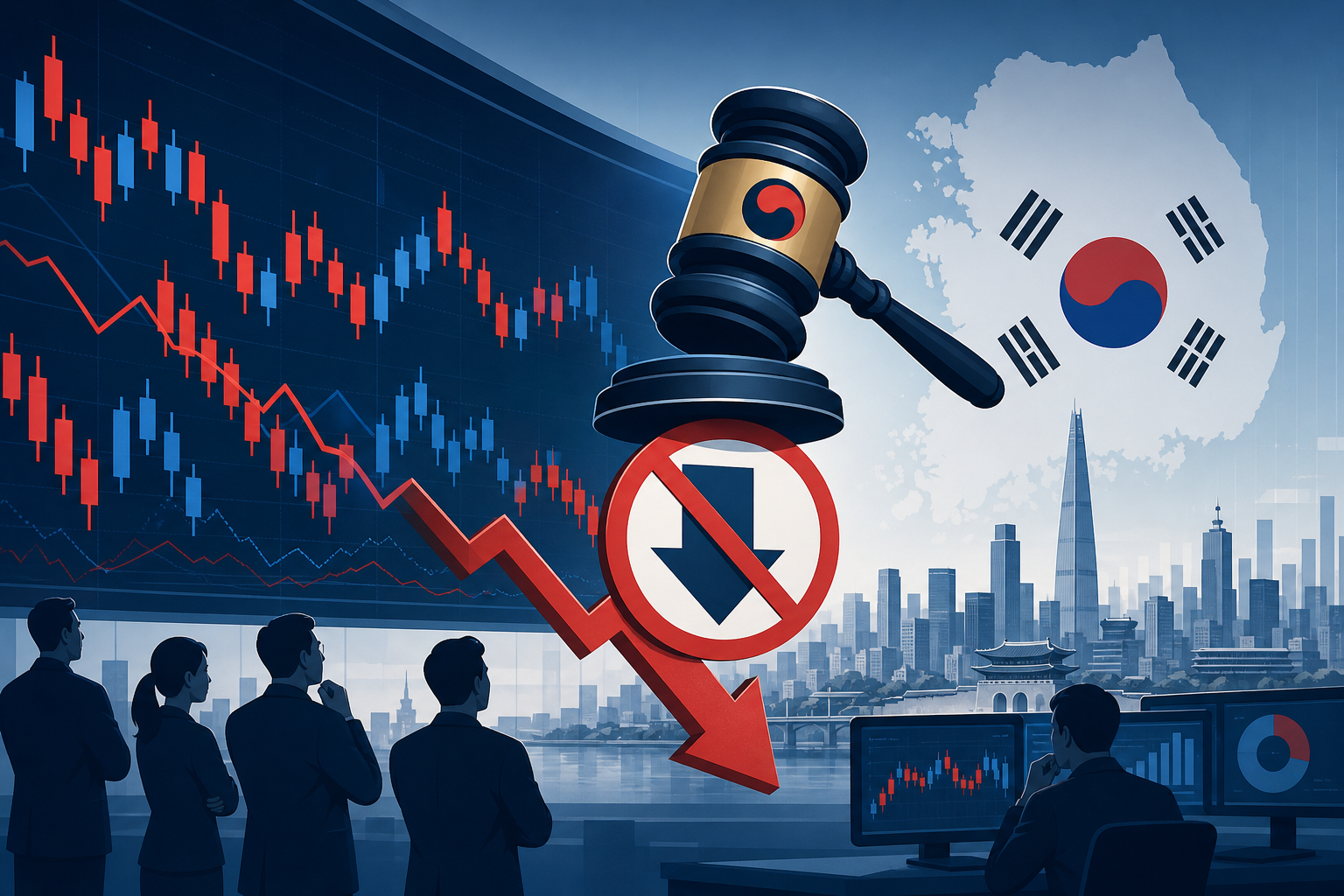
Korea’s stock market has been at the center of a heated structural debate, with retail investors pushing for an extended or permanent short-selling ban even as foreign capital flows and global macro pressures continue to batter the KOSPI. We asked three of our regular analysts to weigh in on whether restricting short-selling is the right medicine for what ails Korea’s equity markets — or whether it’s a dangerous distraction from deeper structural problems.
Let me be direct: blaming short-selling for Korea’s market volatility is like blaming the thermometer for the fever. The KOSPI’s recent sharp declines — approaching 10% drawdowns with circuit breakers triggered — were driven by forces that no short-selling ban can touch. Global institutional funds, particularly those tracking MSCI and FTSE indices, are engaged in systematic rebalancing. JP Morgan estimated that global institutions needed to offload approximately $165 billion in equities to restore target portfolio weights after equities dramatically outperformed bonds in Q2. When that kind of selling pressure arrives, it concentrates on the markets and sectors that rallied hardest. Korea, having ridden the AI and semiconductor wave aggressively, was always going to be near the top of that target list.
What makes Korea uniquely vulnerable isn’t short-sellers — it’s the extraordinary concentration of its market cap. Samsung Electronics and SK Hynix alone account for roughly 57% of KOSPI market capitalization. Add in their proxy holdings — Samsung preferred shares, SK Square, Samsung Life, Samsung C&T — and you’re looking at over 60% of the entire index moving in near-lockstep with global semiconductor sentiment. When the Federal Reserve signals that rate cuts are being pushed back due to resilient U.S. employment data, high-duration semiconductor and AI growth stocks get repriced globally. Korea doesn’t just participate in that repricing — it amplifies it by an order of magnitude.
The short-selling ban petition reflects a retail investor base that is deeply frustrated, and I understand that frustration. But from a macro standpoint, restricting short-selling risks further degrading Korea’s institutional credibility with foreign investors at precisely the moment the country needs to attract stable, long-term capital. Korea’s MSCI emerging market status — rather than developed market — is already a structural discount on the country’s equity valuations. Adding more regulatory friction to the market microstructure will not help that case. The petition might be emotionally satisfying. It will not stop the next rebalancing cycle.
I’ll grant the Macro Bear one thing: the concentration problem in Korean equities is real and it is severe. But I want to focus on something that isn’t getting enough attention in this short-selling debate — the leverage infrastructure that has been quietly built up around this market. Customer deposits in Korean brokerage accounts reportedly reached 110 trillion won, while margin loan balances hit approximately 32 trillion won. When you launch leveraged ETFs on Samsung Electronics and SK Hynix into that environment — as happened recently with their market debut — you are not broadening the investor base. You are concentrating directional risk further and ensuring that any downside move triggers cascading margin calls.
The short-selling ban petition is, at its core, a symptom of retail investors who are trapped in highly leveraged long positions and need the downside pressure to stop. I have sympathy for individuals caught in that position, but the correct policy response is not to remove the market’s price discovery mechanism. The correct response is to address the regulatory permissiveness that allowed margin balances to balloon to these levels in the first place. Governments and regulators who restrict short-selling while simultaneously allowing leveraged retail products on already-concentrated single names are making a category error. They are treating the smoke alarm rather than the fire.
What I find genuinely interesting in all of this noise is the recent regulatory change allowing foreign individual investors direct market access through integrated accounts. That is a structural positive that has been almost completely buried by the short-selling headline drama. Global retail capital — including through platforms like Interactive Brokers — can now flow directly into Korean equities. The order of flows will follow a predictable pattern: large-cap names first, then holding companies trading at NAV discounts, then thematic plays. That is a multi-year demand story that actually moves intrinsic value. Activists and long-term value investors should be focused on that development, not on whether a temporary ban gets extended.
Look, I’m not going to sit here and pretend that short-selling bans are elegant market policy. They’re not. But let’s talk about what’s actually happening on the ground. Foreign investors dumped over 6.2 trillion won in a single session. Institutions followed with another 5.6 trillion won in net selling. The market opened, and for retail participants — who are the ones signing this petition by the millions — it felt like the floor fell out with no circuit breaker on the way down. In that environment, calling for a short-selling restriction isn’t irrational. It’s a demand for breathing room.
The structural argument about Samsung and Hynix concentration is correct, but it doesn’t help you if you bought in last month and you’re watching your position get cut in half. Korea’s market has always had this vulnerability — a handful of chipmakers and their affiliated holding companies effectively are the Korean equity market. Japan has Kioxia, but it’s 4% of the Nikkei. A 10% drop in Kioxia barely moves the index. In Korea, when sentiment turns on semiconductors globally, the entire KOSPI goes with it, regardless of whether every other sector deserves to be sold. That asymmetry is what retail investors are reacting to, and a short-selling ban is their blunt instrument of choice.
Here’s my pragmatic read: the petition will likely result in some form of regulatory response, whether that’s an extension of the existing ban framework or tighter restrictions on naked short-selling. The FSC has proven willing to use these tools before. Smart money should be watching the technical levels on Samsung and SK Hynix and the won-dollar exchange rate as the real leading indicators. If the won stabilizes and foreign selling pressure eases as the global rebalancing cycle completes, Korean equities could recover faster than the doom scenario suggests — ban or no ban. A KOSPI 7,000 scenario getting discussed in the market is real fear, not just noise. But fear at extremes is also where opportunity tends to live for those with dry powder and patience.
Synthesis: A Structural Problem With No Structural Solution in Sight
The short-selling ban petition debate ultimately exposes a tension at the heart of Korean equity market development: retail investors want protection from volatility, foreign institutions want unfettered price discovery, and regulators are caught managing both expectations with tools that only partially address either. The macro pressures — global rebalancing, Fed rate expectations, semiconductor cycle sensitivity — will not be resolved by domestic regulatory decisions. What Korea’s market genuinely needs is deeper diversification of its index composition, a deleveraging of the retail margin loan infrastructure, and consistent, predictable rule-of-law treatment of foreign investors. Whether the short-selling ban is extended or not, those structural reforms remain the real long-term story for anyone with a serious position in Korean equities.