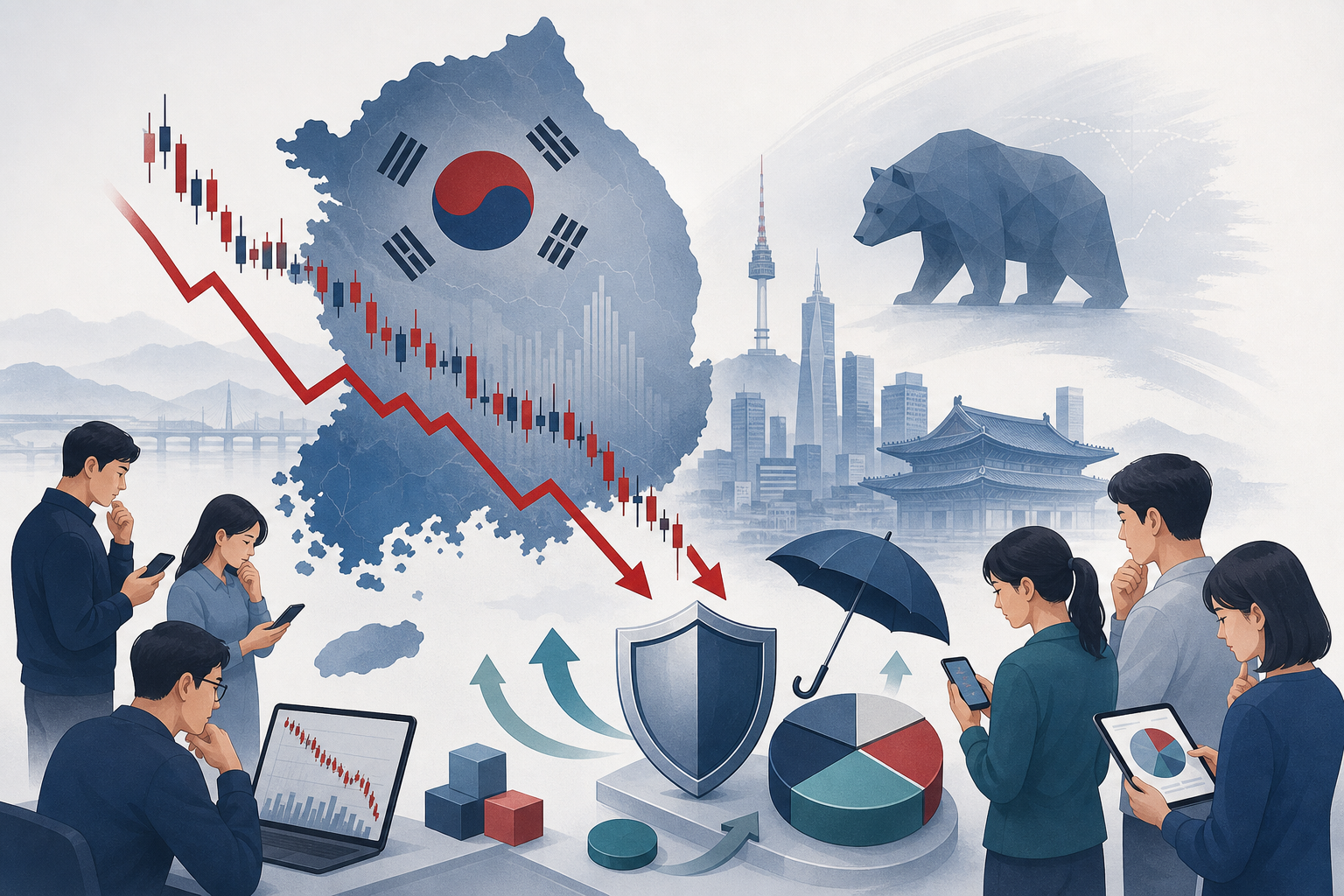
Korea’s stock market has been one of the most volatile battlegrounds for investors in recent memory, with the KOSPI at times shedding nearly 10% in a single session while global peers absorbed far milder blows. As retail investors wrestle with mounting losses and a crisis of confidence, three of our analysts sit down to debate the right strategy for navigating a Korean bear market — and whether the worst is truly over.
Let’s start with the structural reality that most retail investors refuse to accept: the KOSPI is not just volatile — it is systemically prone to violent drawdowns in a way that markets like the S&P 500 or the Nikkei simply are not. When a comparable global shock hits, Korea routinely absorbs two to three times the percentage decline of its peers. Japan fell 3.5% on a day the KOSPI dropped nearly 10%. Taiwan barely moved. This is not bad luck. This is architecture.
The reasons are well-documented if you bother to look at the data. Foreign institutional ownership is disproportionately concentrated in the top two or three market cap names — Samsung Electronics and SK Hynix together represent a gravitational center of gravity that, when foreigners rebalance at half-year and year-end intervals, creates cascading sell pressure across the entire index. Global passive funds tracking MSCI and FTSE indices don’t make emotional decisions. They rebalance mechanically, and when Korean equities outperform, those same funds trim exposure just as relentlessly. The market drops not because something is fundamentally broken, but because the plumbing forces it.
What concerns me more heading into the second half of the year is the broader macro backdrop. Consumer sentiment indicators are rolling over. The Federal Reserve’s policy trajectory remains uncertain, and any pivot in Fed communication — particularly around the August-September window — could trigger renewed risk-off flows out of emerging markets. Korea, as a high-beta, export-sensitive economy sitting at the intersection of AI hardware demand and geopolitical semiconductor regulation, is exceptionally exposed. Retail investors celebrating any bounce should ask themselves: is this a recovery, or is this just the eye of the storm?
With respect to my colleague, the macro framing, while accurate in its mechanics, misses the more important question: what are you actually buying, and at what price? Bear markets are not tragedies for disciplined investors. They are, historically, the only reliable mechanism through which genuinely undervalued assets become accessible to those willing to do the work.
The Korean discount — the persistent gap between intrinsic value and market price that has plagued the KOSPI for decades — is not a new phenomenon. What is new, and genuinely interesting, is the regulatory shift around foreign individual investor access. The recent relaxation of omnibus account restrictions means that global retail capital — think Interactive Brokers users in Europe and North America — can now flow directly into Korean equities in a way that was previously blocked. This is a structural supply-demand change that the market has barely begun to price in. When global individual investors start screening for NAV discounts and holding company structures at 40-50% discounts to fair value, that arbitrage opportunity doesn’t persist forever.
KOSPI 7,000 scenarios are circulating in domestic analyst circles — not as base cases, but as possibilities worth modeling if corporate governance reform accelerates and foreign inflows respond to improved capital return policies. I’m not predicting that outcome. But I am saying that at current valuations, with select large-caps trading at PER ratios that would be considered distressed in any other developed market, the math of long-term compounding favors the buyer, not the seller. The retail investor panic-selling into a 10% down day is doing the institutional buyer a very generous favor.
Both of you are right, and both of you are completely useless to someone sitting on a 30% loss in their brokerage account right now. Let me tell you what’s actually happening on the ground.
Korean retail investors — 개미, the individual traders who flooded into the market during the pandemic era — are exhausted. Not just financially. Mentally exhausted. The posts on Korean investment forums tell you everything the data doesn’t: people who held “good companies” at reasonable valuations watched those positions go nowhere for two years, then crater when the broader market sold off. Short selling from institutional players, mechanical index rebalancing that looks indistinguishable from manipulation to someone watching their screen tick down, and a government that talks about capital market development but whose policy signals remain inconsistent — this is the environment retail investors are operating in. The investment fatigue is real and it’s showing up in trading volumes and in the tone of the commentary coming from previously active bloggers.
That said, here’s what the smart money is actually doing, and it’s not complicated: they built their watchlists before the crash. The investors who performed well during recent volatility were not the ones scrambling to react — they were the ones who had already done the fundamental research and were waiting for exactly this kind of disorderly sell-off to execute. The playbook is as old as markets: brutal research in calm weather, decisive buying in the storm. What I’d add specifically for the Korean context is this — when you see circuit breakers triggered and foreign rebalancing creating mechanical, non-fundamental selling, that is categorically different from a market pricing in genuine earnings deterioration. One is an opportunity. The other is a warning. Right now, parts of the KOSPI look like the former. But you need to know your individual names cold before that distinction is actionable.
The other thing I’ll say for retail investors specifically: diversified, all-weather portfolio structures — allocating across assets in ways that dampen volatility without sacrificing long-term return — have quietly proven their worth this year. The investors who could sleep through the US-Iran turbulence and the AI sector rout weren’t the ones who called the bottom correctly. They were the ones who didn’t need to call it.
The three perspectives converge on an uncomfortable but clarifying truth: the Korean bear market is simultaneously a structural problem, a valuation opportunity, and a psychological test — and the correct response depends entirely on which of those lenses you are equipped to apply. The Macro Bear is right that global liquidity conditions and Korea’s market architecture make further volatility not just possible but probable. The Value Hunter is right that patient, research-driven investors buying quality at distressed prices will likely be vindicated over a multi-year horizon, particularly as foreign access improves and governance reform progresses. And the Street Pragmatist is right that strategy is irrelevant without the emotional and operational discipline to execute it. For Korean retail investors navigating this market, the most dangerous position is not being wrong about the direction — it’s being unprepared for the volatility that makes being right feel indistinguishable from being wrong.